The island of Haiti/Dominican Republic is called Hispaniola. There is a border right down the middle that separates two distinct ethnic groups, the Haitians and the Dominicans. Haitians speak Creole language and Dominicans speak Spanish. There is unspoken conflict between the two ethnicities though some Haitians and Dominicans are friends.
The history of the island is entrenched in pirates of the Caribbean. Not far north is Tortuga Island and Turks and Caicos. Many pirates from other countries such as France, England, and the Netherlands, and Spain, took the best resources from Hispaniola and left the island deplete of natural resources.
When it rains it pours. The Haitien side of the island is steeped in poverty and many of the population live hungry every day. There is little infrastructure to provide good roads or clean water which are both necessary to build an economy that is sustainable. This whole island is in the path of hurricanes every season.
On the Dominican side the government decided to invest in tourism to build the economy and this has worked out for them very well. There are pockets of poverty still in the Dominican, yet the job possibilities seem available for many who can afford to migrate there. Columbus sailed to Dominican Republic in 1492. History tells us that Columbus was a terrible governor and leader. His reputation is quite bleak when touring museums of their history. The Dominicans refused to let Columbus be buried on the island.
Sugar cane is a cash crop and is labor instinctive. Slaves were brought in to fulfil that labor need. Because of the many slaves brought in, it was difficult for them to have known how to care for the land as they were orphans from their homelands in a strange land and no one had taught them of their heritage or caregiving in this strange land they found themselves living in.
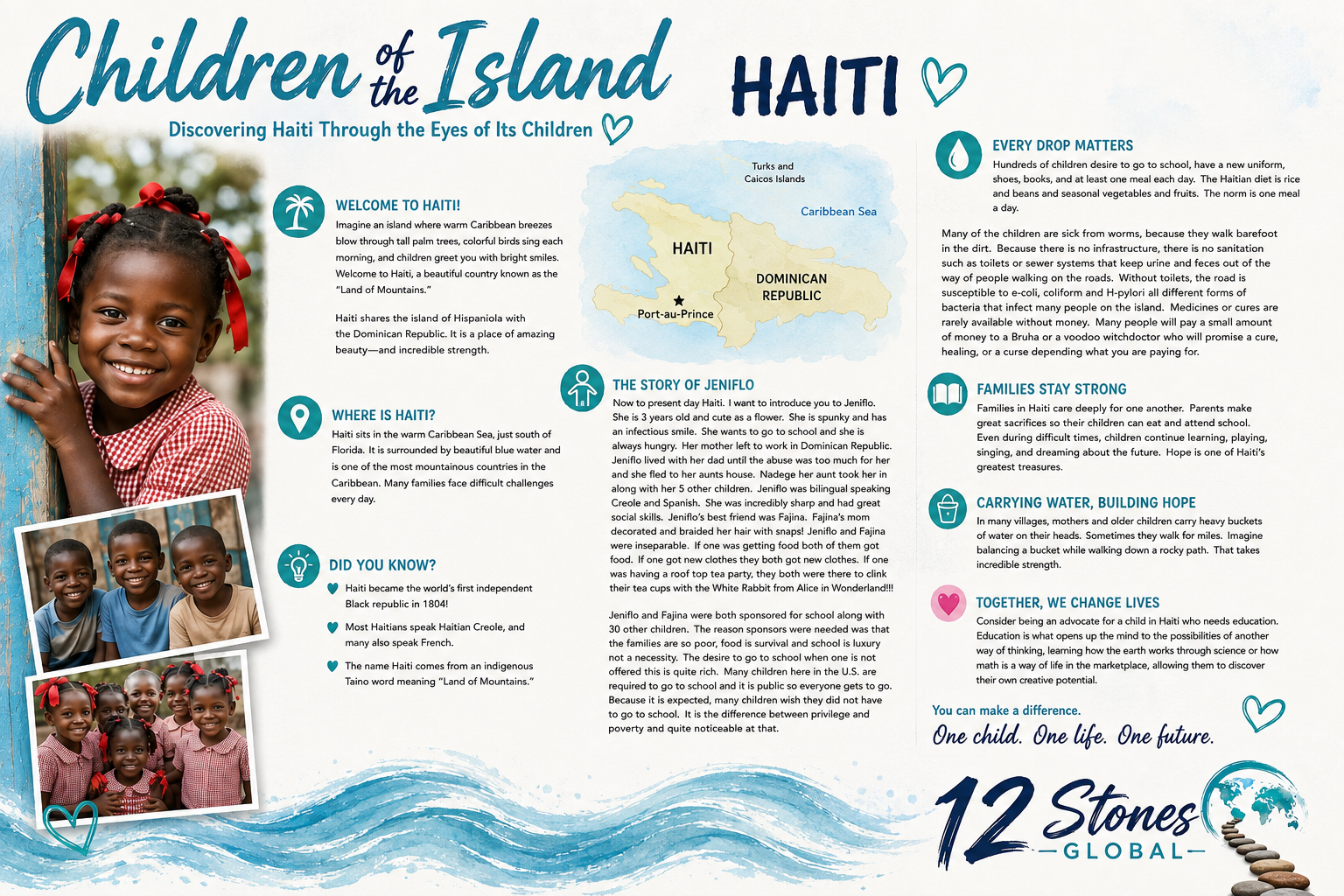
Now to present day Haiti. I want to introduce you to JeniFlo. She is 3 years old and cute as a flower. She is spunky and has an infectious smile. She wants to go to school and she is always
hungry. Her mother left to work in Dominican Republic. Jeniflo lived with her dad until the abuse was too much for her and she fled to her aunts house. Nadege her aunt took her in along
with her 5 other children. Jeniflo was bilingual speaking Creole and Spanish. She was incredibly sharp and had great social skills. Jeniflo’s best friend was Fajina. Fajina’s mom decorated and
braided her hair with snaps! Jeniflo and Fagina were inseparable. If one was getting food both of them got food. If one got new clothes they both got new clothes. If one was having a roof top
tea party, they both were there to clink their tea cups with the White Rabbit from Alice in Wonderland!!!
Jeniflo and Fagina were both sponsored for school along with 30 other children. The reason sponsors were needed was that the families are so poor, food is survival and school is luxury not a necessity. The desire to go to school when one is not offered this is quite rich. Many children here in the U.S. are required to go to school and it is public so everyone gets to go. Because it is expected, many children wish they did not have to go to school. It is the difference between privilege and poverty and quite noticeable at that.
Hundreds of children desire to go to school, have a new uniform, shoes, books, and at least one meal each day. The Haitian diet is rice and beans and seasonal vegetables and fruits. The norm
is one meal a day. Many of the children are sick from worms, because they walk barefoot in the dirt. Because there is no infrastructure, there is no sanitation such as toilets or sewer systems that keep urine and feces out of the way of people walking on the roads. Without toilets, the road is susceptible to e-coli, coliform and H-pylori all different forms of bacteria that infect
many people on the island. Medicines or cures are rarely available without money. Many people will pay a small amount of money to a Bruha or a voodoo witchdoctor who will promise a cure, healing, or a curse depending what you are paying for. Voodoo is the island of Haiti’s main religion. Voodoo is not something you play around with as it is a very real, dangerous and dark way of living and thinking in the world. The word religion basically means boundary. A boundary is like a fence that we put up around our life to answer real questions about the world we live in, what we allow in and what we keep out. Imagine a whole island of people who
include the dark and demonic spirit world to answer their questions of life around them and to allow in, the spirits of darkness to control life’s ups and downs, curses instead of blessings, hate instead of love, fear instead of peace.
Consider being an advocate for a child in Haiti who needs education. Education is what opensup the mind to the possibilities of another way of thinking, learning how the earth worksthrough science or how math is a way of life in the marketplace, or how English can open upfriendship possibilities or jobs to interpret for foreigners who visit the island. Without education children stay closed to only what they see around them, and become subject to tales ofuntruth, bad theology, wrong thinking and hate.
May you pray blessings over Haitian and not cursing! May you pray for peace amidst the fear and violence Haitians experience on a daily basis. Pray for the church of Jesus Christ to seek truth and to serve and love their neighbor as themselves. May the Haitians love the Lord theirGod with all their heart, soul and mind. May truth overcome lies and may love overcome a long history of hate and injustice. Along with your prayers you can sacrifice and save money to support the Christian work in Haiti, sponsor a child for school and provide food on a daily basis. Remember that Haiti is just 2 hours by airplane off the coast of Florida, U.S.